
Plants
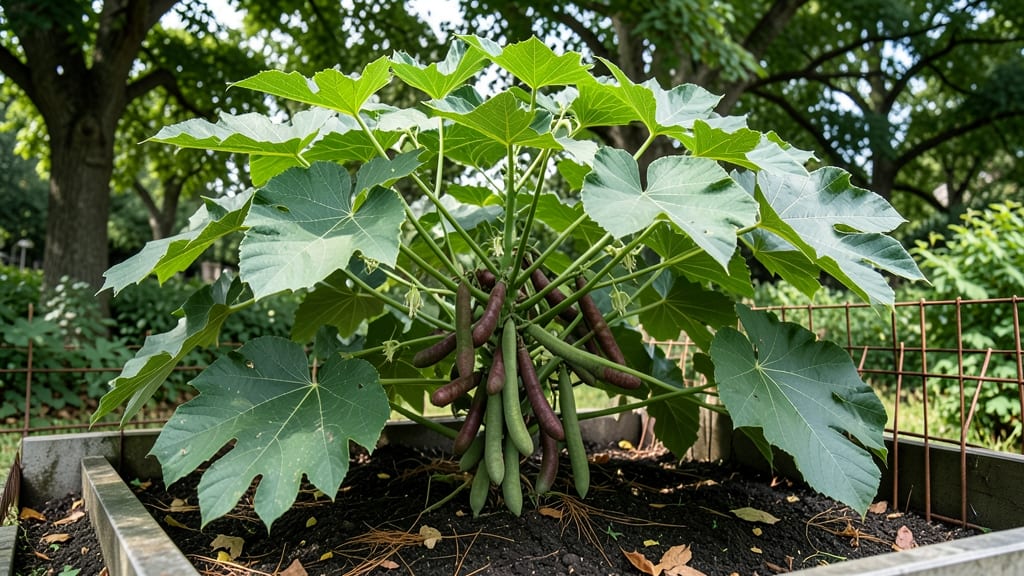
Castor beans look like glossy, mottled oval seeds measuring about 1 to 2 centimeters long, nestled inside spiky greenish-brown pods shaped like elongated fingers on the Ricinus communis plant. These seeds are smooth with brown or black speckles, while the plant features deep green, fan-shaped leaves and can reach heights of 6 to 10 feet.
When you spot these seeds in nature, you'll notice their striking contrast against the plant's vibrant foliage. 🌱 The pods develop from small green flowers that eventually harden into their characteristic spiky shells, which can be up to 3 centimeters long.
What makes them stand out is their toxicity—never consume them, as they contain ricin, one of the most potent natural poisons. The plant itself thrives in warm climates and often grows alongside ornamental palms, which can lead to confusion if you're not familiar with its unique seed patterns.
One helpful trick for identification is to look for the plant's distinctive palmate leaves, which resemble those of a castor oil plant. The mature seeds are particularly striking when dry, with their glossy finish and irregular coloration standing out against the plant's deep green leaves.
Always handle with care, as even minor contact with broken seeds can be dangerous.
💡 In This Article
- Identifying Castor Bean Seeds and Pods Up Close
- Castor Plant Growth Stages and Habitat Clues
Identifying castor bean seeds and pods up close
The castor bean's seed morphology is one of nature's most striking examples of visual contrast. Each seed measures 1.5 to 2 centimeters in length, with an oval shape that tapers slightly at both ends.
What makes them instantly recognizable is their glossy, almost waxy surface that reflects light in a way similar to polished river stones.
The coloration is what truly sets them apart—these seeds are rarely uniform, instead featuring irregular mottling of brown, black, and tan spots against a lighter background, creating a marbled effect that's unique in the plant kingdom.
When examining the pods, you'll notice their spiky, finger-like structure that can grow up to 3 centimeters long when mature. The pods start green and soft when young, gradually hardening and developing their characteristic greenish-brown hue as they mature.
Each pod typically contains 1 to 3 seeds, though some may contain none at all.
The spines along the pod's surface are particularly sharp—measuring about 2 millimeters in length—and serve as a natural defense mechanism against predators. 🔥 These spines are most pronounced when the pod is fully mature, making them easier to identify at that stage.
The key to distinguishing castor beans from similar-looking seeds lies in their surface texture and color patterns. Unlike jatropha seeds—which have a more uniform brown color and less pronounced mottling—castor beans exhibit that distinctive marbled appearance.
Croton seeds, another potential lookalike, tend to be smaller (0.5 to 1 centimeter) and lack the glossy finish.
Another critical visual clue is the seed's size relative to the pod: castor seeds occupy nearly the entire interior space of the pod, leaving minimal empty space, unlike some other toxic seeds that rattle when shaken.
One often-overlooked identification feature is the seed's hilum—the small scar where the seed was attached to the pod. In castor beans, this appears as a tiny, pale line along one edge, often barely visible but distinctive under close examination.
This feature helps differentiate them from seeds that have a more pronounced attachment point. The hilum's position and size can also indicate the seed's maturity—younger seeds may have a more prominent hilum that fades as the seed ages.
For those concerned about toxicity, remember that the entire seed is dangerous, but the outer seed coat contains the highest concentration of ricin. When crushed, this releases the toxin, which is why handling broken seeds requires immediate and thorough washing.
The seed's internal structure also reveals its toxicity—when split open, you'll see a white, mealy endosperm that contrasts sharply with the darker outer layers. This internal coloration is another key identifier when examining seeds in cross-section.
Consider these visual comparison points when identifying castor beans:
- Size: 1.5-2 cm long (jatropha seeds are 1-1.5 cm)
- Surface: Glossy with marbled brown/black spots (uniform color in lookalikes)
- Pod spines: Sharp 2 mm projections (softer in similar pods)
- Seed count per pod: Typically 1-3 seeds (often more in non-toxic lookalikes)
- Hilum appearance: Small pale line (more pronounced in other seeds)
The seed's striking appearance serves as both an identification tool and a warning—nature's way of signaling danger through visual contrast. Always approach unknown seeds with caution, especially when you encounter this distinctive marbled pattern against the plant's deep green leaves. 💫