
Planting
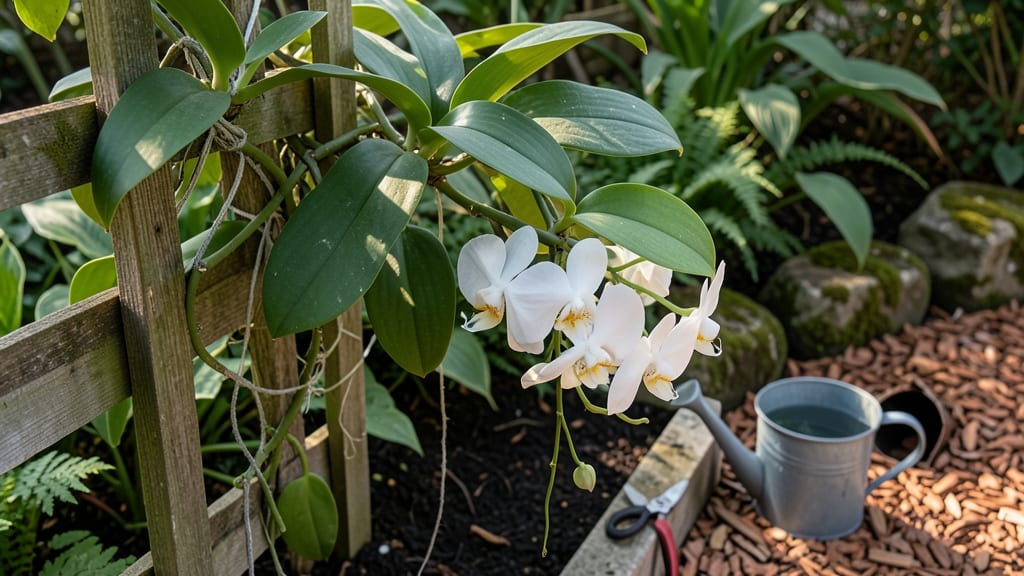
Vanilla beans come from the orchid plant Vanilla planifolia, a tropical vine native to Mexico and Central America, prized for its fragrant pods used in flavoring and perfumes. This evergreen climber thrives in warm, humid climates with support structures like trees or trellises.
Vanilla beans actually grow on a type of orchid vine belonging to the genus Vanilla, with Vanilla planifolia being the most commercially important species. 🌿 These vines produce the signature pods we use in baking and beverages, but they're surprisingly delicate plants that require very specific growing conditions.
The pods themselves develop from the vine's flowers, which only bloom for a single day—making hand-pollination a crucial step in cultivation. Many people don't realize these orchids are actually climbers that need constant support to grow properly, unlike most flowering plants.
What makes vanilla orchids particularly fascinating is their complex relationship with their pollinators. In the wild, only certain bees and hummingbirds can effectively pollinate the flowers, which is why commercial growers often have to hand-pollinate each flower individually.
This process requires precision timing since the flowers only remain receptive for about 12 hours. The resulting pods then take several months to mature, developing their signature aroma and flavor compounds through careful curing processes.
💡 In This Article
- Vanilla Orchid Species: Types and Botanical Traits
- Growing Vanilla Orchids at Home: Essential Tips
Vanilla orchid species: types and botanical traits
The vanilla orchid genus contains over 110 species, but only three produce the aromatic pods we recognize: Vanilla planifolia (the "Bourbon vanilla"), Vanilla tahitensis (Tahitian vanilla), and Vanilla pompona (West Indian vanilla). Vanilla planifolia, native to Mexico's coastal regions, produces the classic vanilla flavor with 2% vanillin—the compound responsible for its signature aroma.
This species thrives in 20-30°C (68-86°F) temperatures with 70-90% humidity, mimicking its tropical rainforest habitat.
The pods themselves are actually elongated, leathery fruits containing thousands of tiny black seeds.
When mature, they measure 10-20 cm (4-8 inches) long and turn from green to yellow-brown—a sign of ripeness. Vanilla tahitensis, found in Tahiti and Fiji, produces smaller pods with a floral, fruity profile due to its higher vanillin content (up to 3%) and cooler growing conditions (18-28°C / 64-82°F).
Meanwhile, Vanilla pompona from the Caribbean has a more complex, spicy flavor with lower vanillin (1%) but higher levels of coumarin, giving it a unique aroma reminiscent of hay.
What makes these orchids botanically unique is their epiphytic growth habit—they don't grow in soil but attach to trees using aerial roots while absorbing moisture and nutrients from the air.
The vines can reach 30 meters (100 feet) long if given proper support, producing flowers only after 3-5 years of growth. Each flower lasts just 12 hours, during which it must be pollinated to develop into a pod.
This delicate balance explains why commercial vanilla production requires such precise environmental control and human intervention.
Climate plays a crucial role in flavor development. The high humidity (80%+) of Madagascar—where 80% of the world's vanilla is grown—creates ideal conditions for pod maturation.
Lower humidity (60% or less) can cause pods to dry out prematurely, while excessive rain (over 200 cm/year) increases fungal risks. Temperature fluctuations also matter: Nighttime drops below 15°C (59°F) can stunt flower production, while daytime highs above 35°C (95°F) stress the plants, reducing pod quality.
The difference between species extends to their chemical profiles. Vanilla planifolia contains 118 known aromatic compounds, while Vanilla tahitensis has 130+ due to its cooler growing environment promoting different chemical pathways. This explains why Tahitian vanilla tastes more floral and less sweet than Bourbon vanilla.
Even within Vanilla planifolia, altitude affects flavor: pods grown at sea level develop richer vanillin, while those at 1,000+ meters have higher levels of p-hydroxybenzaldehyde, contributing to a spicier note.
For home growers, selecting the right species matters. Vanilla planifolia is the most forgiving for beginners due to its faster growth rate (2-3 years to first flowers) compared to Vanilla tahitensis (5+ years). However, all species require constant 12-hour daylight and daily misting to mimic tropical conditions.
The pods' aroma develops through a 6-week curing process after harvest, where enzymes break down complex compounds into simpler aromatic molecules—this is why freshly harvested pods taste bland compared to their cured counterparts.